Vidhan Atlas stores the law the way lawyers reason; add your matter, and we build the argument — showing the exact passage that supports each point, and why.

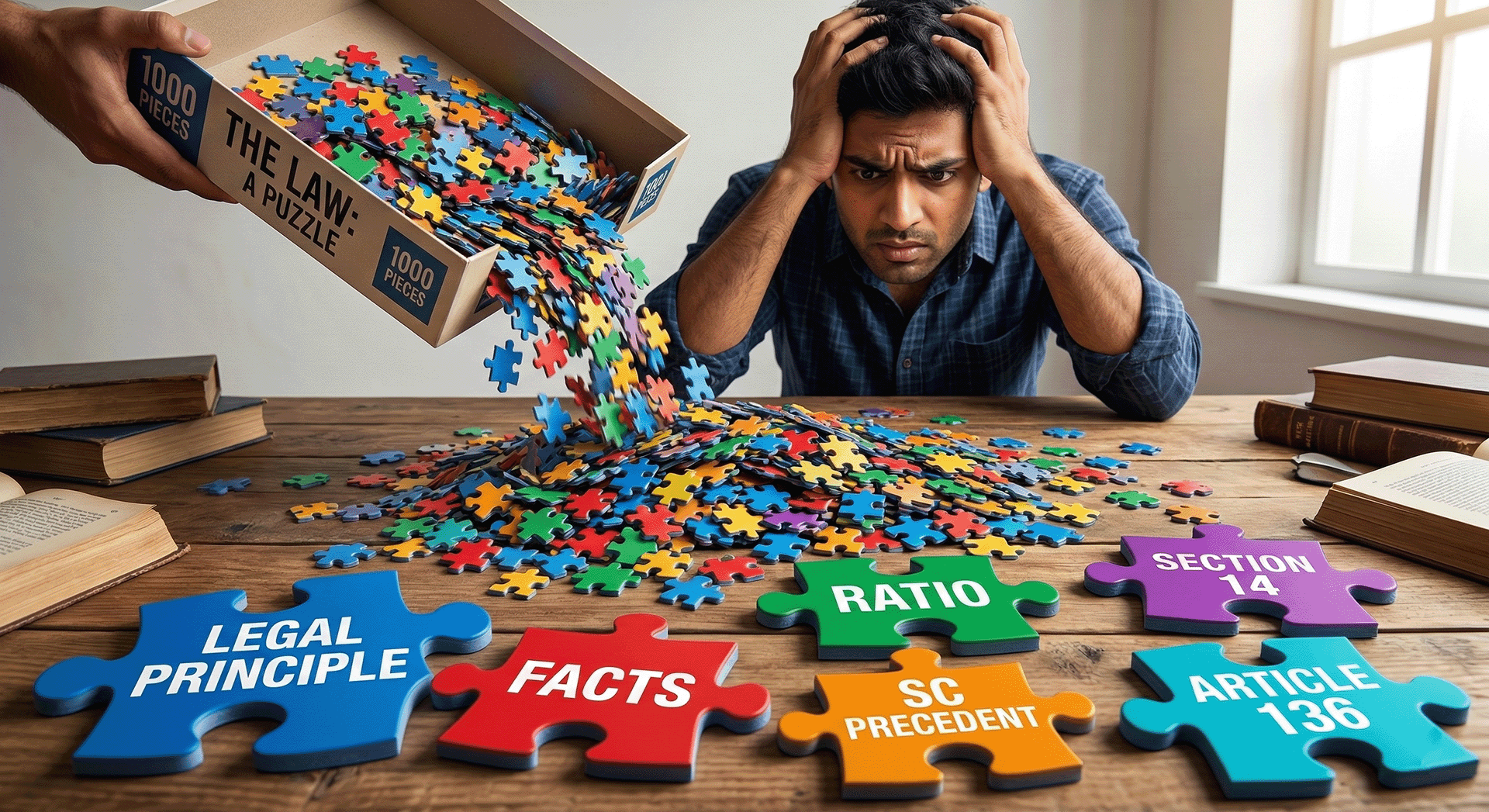
The database dump. Pieces, but no picture. Hours sunk asking: Is it relevant? Do the facts match? What's the Ratio? Am I missing something?

See the logic. See the big picture. See the strategy.
Existing legal databases organise law for retrieval — keyword search, classification, citation lists. Atlas organises law for reasoning — by ratio, by argument structure, by logical chains and their higher dimensional cousins.
Builds the chain that connects your facts to your desired outcome — with paragraph-level citations at every step.
Stress-tests your argument against the strongest counters — and tells you where the chain breaks.
Surfaces the threats your argument is exposed to — a document the opposition could produce, a witness who could shift the bench.
Recommends the next move — what to file, what to discover, who to prepare — ranked by impact on your case.
Extracts the binding ratio from any judgment — separated from obiter, facts, and procedural detail.
Flags overruling, distinguishing, or conflicting judgments your authorities depend on — before opposing counsel does.
Powered by Mathematical Reasoning Algorithms
We're testing the interface with a small cohort of corporate disputes counsel. Apply to join them and see Vidhan work on a real fact pattern.
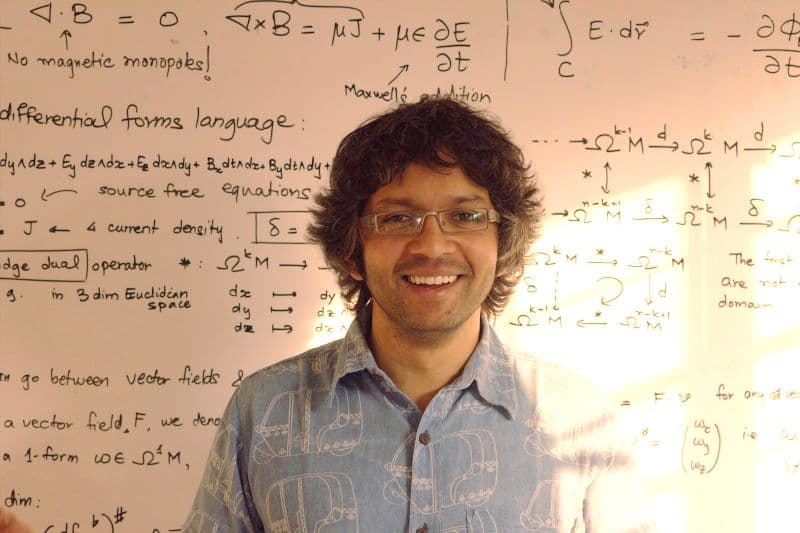
Three founders. One thesis: legal reasoning has a geometric structure — and geometry can be navigated.

Full-stack AI systems builder. Math, visual arts, video AI, and hardware.
Math PhD, Princeton · IIT Bombay · Built mission critical systems across automotive (Mercedes Benz), media (Viacom18), medical devices/imaging and Indian armed forces

Mathematician, ML engineer and Serial entrepreneur
Math PhD, IISER Pune · IIT Madras · Cambridge ELLIS · TIFR Postdoc · Already shipped a SaaS to 50+ paying clients.

Systems architecture and agentic AI design
Math PhD, Princeton · IIT Bombay · INSA Young Scientist · Former Math Dept Chair, IISER Pune · Fellow of Indian Academy of Sciences · 20 years teaching and PhD advising experience.
Former District Judge, CJJD & JMFC
Senior legal adviser and mentor
LLM Graduate, Practicing Advocate
Legal Adviser
We only use ZDR (Zero Data Retention) api calls and only to convert your data from natural language to mathematics. No "model training" or any other "model improvements" are being done to our system using your data - Once it is converted to the mathematical representation, the reasoning is done using mathematics and not deep learning or gen AI. Vidhan Atlas never uses your data. Only you use Vidhan Atlas' data and insights. So your data is safe from becoming part of any of our models or reasoning systems. We also follow all industry standard data security and privacy practices. We do not store any documents/files uploaded in their original form after a given session is over (for example after you logout).
Hallucinations are an artifact of generative AI (e.g. LLMs). In our systems, the only places where LLMs or any generative AI is used are 1. for converting your natural language inputs (documents, comments etc) to our proprietory mathematical format (similar to a mini version of our Vidhan Atlas but for your data) 2. for orchestration 3. to convert the mathematical output of our algorithms to human readable natural language (currently english). The actual reasoning is done using mathematics on mathematical objects. So the chances for hallucination are virtually zero. Every passage that Vidhan cites comes directly from the actual judgment text — it doesn't paraphrase, it doesn't generate.
Vidhan Atlas is currently built with laws relevant for commercial/corporate concerns (currently about 100+). The list of laws currently in Atlas can be found here. We are currently in the process of mathematizing judgements from Supreme Court of India and major High Court judgments, focused on commercial disputes and arbitration. Coverage expands every month — when you apply, tell us what you work on so we can prioritise. Having said that, you can always upload any text including pdfs of acts you think may be relevant, or judgements that may have a bearing on the case, as part of your documents and vidhan will include them in its analysis.
Free access to the demo for the end of MVP testing or till a fixed usage limit, whichever is earlier. We ask for a short onboarding call, feedback after you try Vidhan on a couple of real matters, and one usage interview. We're looking for testers who want to shape Vidhan around their actual needs — not just kick the tyres. Anything you share stays private; We'll always ask permission before sharing your identity publicly. No payment, no long-term commitment.
Still have questions? Apply for early access — we'll answer them on the onboarding call.
Join the next cohort of Vidhan testers. Free for the duration of MVP testing, with no long-term commitment.
You shape what we build first. Everyone else inherits your priorities.
Reviewed within a week. Tell us what you work on so we can prioritise.